
Reno vs. Las Vegas: Regional Differences in Vintage Chip Design
Regional differences have significantly shaped the gambling chips of both Reno and Las Vegas. Las Vegas was in its Strip-era resort glamour, while Reno was a smaller downtown club market. These differences show up when discussing Reno vs. Las Vegas casino chips.
Significant differences in chip artwork, casino count, and collector demand are still visible between Reno and Las Vegas casino chips, which make up a huge part of vintage Nevada casino chip collections.
Why Do Collectors Treat Chip Regions as Separate Specialties?

Chip collectors do not collect broadly; instead, they specialize by region. Casinos have been legal in Nevada since the 1930s, and the number of historical US casinos is so vast that collecting the casino chips together is somewhat impossible. That is why region-based collecting is more practical.
Within Nevada, collectors choose certain regions as their focus area. Las Vegas has the most popular regional specialty because of its cultural significance and high market demand and value. Reno and Tahoe are well-established secondary markets after Las Vegas, as they were major gaming hubs from the beginning.
Collectors choose a region between Las Vegas, Reno, Sparks, and Lake Tahoe and specialize in a regional casino chip specialty. They collect casino chips from the region they choose to have a manageable and financially achievable collection.
How Did Las Vegas and Reno’s Different Gambling Scenes Shape Chip Design?
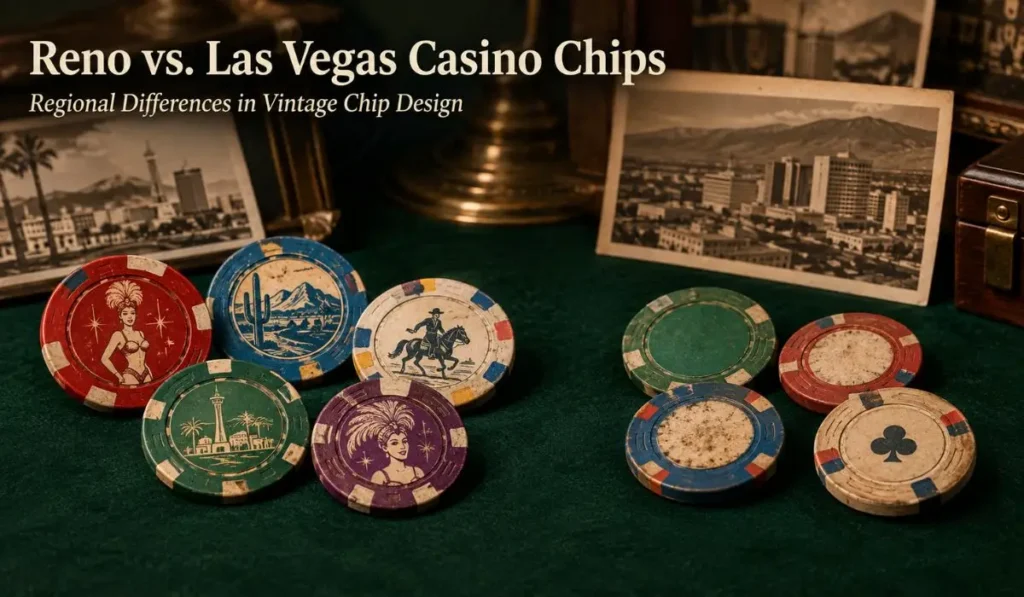
Casino chip designs have evolved over the years. Las Vegas Strip casino chip designs from the mid-20th century are artworks that reflect the Strip’s resort-driven glamour. Reno produced more smaller-denomination club chips during that period.
Las Vegas: Most casino chips produced in Las Vegas reflected the Strip’s resort-driven glamour, featuring Western and showgirl motifs. These motifs were associated with casinos such as Sands and Desert Inn. Some of the most famous house-molded chips in Las Vegas came from Sands and Dunes. They used artwork on the casino chips to market Las Vegas as a destination.
Reno/Downtown Nevada clubs: Casino chips from smaller-footprint casinos that were focused on Reno and other downtowns in Nevada were mostly simpler and more utilitarian. They were linked to long-running local clubs and were not part of resort branding.
These generalizations may not always hold for all casino chip designs, as there are exceptions. Therefore, Las Vegas or Reno casino chip collecting should involve verifying a casino chip against the individual casino’s history before assuming a regional pattern.
Did Reno and Las Vegas Casinos Use Different Materials or Manufacturers?
Reno and Las Vegas casinos generally used the same national pool of chip manufacturers and materials; therefore, identifying the casinos that used the chips may not be useful. Manufacturer records and mold styles can narrow down the place and time of the chip, but the material alone will not be of much use in identifying the chip’s region.
Most casinos in Reno and Las Vegas used compressed clay composite formulas for making casino chips in the early days. In the late 20th century, ceramic polymer technology emerged, leading to the adoption of digital ceramic casino chips. As most of these chips were made by third-party companies, both Reno and Las Vegas can have similarities, making the materials unreliable for identifying the region.
Mold manufacturers such as TR King made vintage Nevada casino chips, and the mold hub records and manufacturer marks can be considered more reliable identifiers. Nevada casino chips can be identified after checking the physical attributes and cross-referencing databases.
For additional regulatory and historical context, collectors can also consult the Nevada Gaming Control Board, which maintains information and regulations concerning casino chips and tokens.
How Does Rarity and Value Compare Between Reno and Las Vegas Chips?
Las Vegas has the largest and most active casino chip collector base in Nevada. Obsolete Las Vegas chips tend to have stronger demand and resale prices compared to Reno chips, even when both are similarly scarce. The value of a casino chip is based on rarity, location, aesthetic appeal, mold, and condition.
Rarity and demand increase the value of casino chips, especially that of obsolete Nevada casino chips. But a rare Reno club chip can still be undervalued compared to a rare Vegas Strip chip because of the popularity and the narrative connected to Las Vegas of mobs and the Strip being created around it. However, some very rare Reno chips in their best condition with significant casino history can sometimes be more valuable than Las Vegas chips.
Casino closures and short operating windows led to obsolete chips, leading to scarcity in both Reno and Las Vegas casino chip markets. Casinos usually produce chips in limited numbers when they start their operations, and if they shut down in a short time period, the initially produced chips would be the only ones, making them scarce. Mandatory removal or destruction of obsolete chips was done to prevent fraud and counterfeiting, adding to the scarcity.
Where Does Lake Tahoe Fit Into the Regional Picture?
Lake Tahoe is grouped with Reno as a secondary Northern Nevada collecting market. They have their own resort-lake identity but mostly share the same casino operators and club-driven chip style as Reno casinos.
Lake Tahoe casino chips have a unique aesthetic and represent a distinct collecting niche, reflecting the area’s resort and casino history.
Some collectors treat Reno and Tahoe as one combined specialty, as many of the casinos had locations in both cities. Companies produced dual-branded casino chips that were stamped with both locations and were somewhat impossible to distinguish between.
As Reno and Tahoe casino chips are treated as a single category, auctions are done by putting these chips under the same category, so sourcing them into the right catalogue can be difficult.
How Can Collectors Identify a Chip’s Regional Origin?
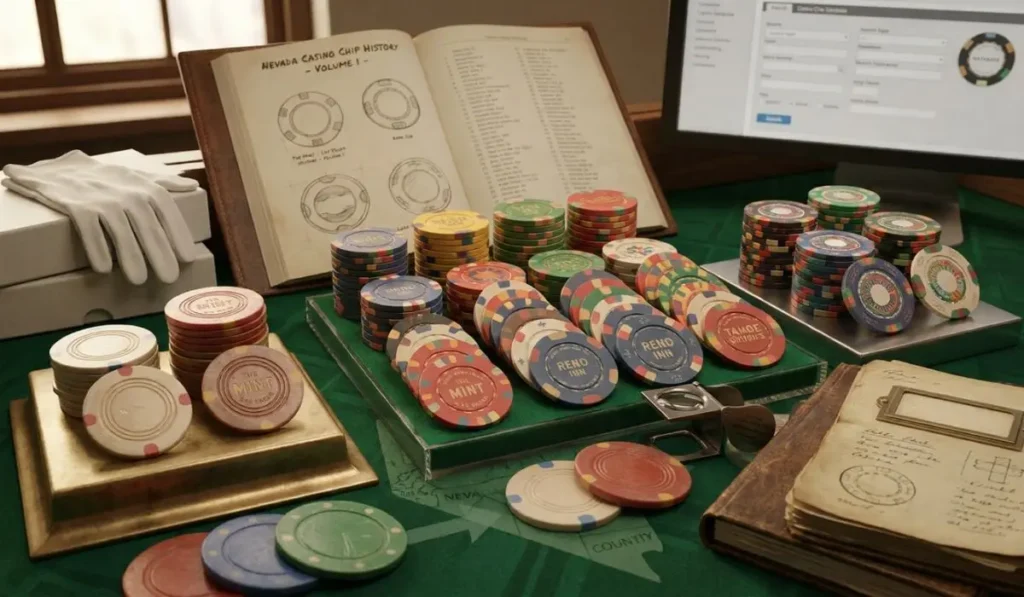
Most casino chips have the casino name and city printed or inlaid on the chip, through which collectors can identify the chip’s regional origin. They can cross-reference it against known regional chip databases such as ChipGuide and club records.
The casino’s brand, face value denomination, and sometimes local motifs are on the casino chips either as inlays or hot stamps. Sometimes chips are rebranded with the property transitions, and that too can be read from the chip.
Databases such as ChipGuide.com, which is owned and operated by the Museum of Gaming History, can be used to confirm a casino’s operating city and years. They cross-reference molds and manufacturer codes to identify and verify the origin of the casino chip.
Collectors can join regional clubs or organizations like the Casino Collectibles Association (CCA) to learn about trade networks and physical examination of casino chips. You can also gain knowledge through peers and can get access to educational seminars and resources for specializing.
Conclusion
Both Reno and Las Vegas casinos produced chips that are indicators of two different gambling cultures. Reno vs. Las Vegas casino chips is resort-driven Strip glamour versus a smaller downtown club scene.
Casino chip collectors need to understand the regional context to build a casino collection that is well researched and focused. Most experienced collectors tend to be region-specific because of the sheer number of casinos in both Reno and Las Vegas.
Frequently Asked Questions
Las Vegas casino chips are generally more valuable compared to Reno chips because of the larger collector base and demand. But in rare situations, because of individual rarity, condition, and casino history, specific Reno chips can be more valuable.
Is Lake Tahoe considered part of the Reno chip-collecting region?
Lake Tahoe is considered part of the Reno chip-collecting region, as some operators are the same, and club-driven chip styles are also similar. Therefore, collectors consider them a Northern Nevada specialty and not as different groups.
No, the chips’ region cannot be identified by their material. Casino chips from Reno and Las Vegas casinos mostly use the same manufacturers. Looking for the casino name and city on the casino chip can be more reliable.
Western or showgirl imagery is part of the artwork that reflected the Strip’s mid-20th century resort rebranding. Themed imagery was used by various casinos, like the Sands, to market Las Vegas as a destination, and the artwork was part of it.
Choose a region from Las Vegas, Reno, and Tahoe. Do thorough research on their casino history. Verify the chips using identification databases and regional clubs before buying.