

The History of Casino Chips: From Ivory to Clay Composite
The history of casino chips traces the fascinating evolution of chaotic frontier currencies into highly sought-after, secure financial instruments. The casino chip evolution will take you from improvised tokens like ivory, bone, and coins in the 1800s to uniformly cold clay in the 1880s and the highly advanced, durable clay composite ceramic chip collections available today. Understanding casino chip history is necessary to know the worth of a chip you are holding on to.
Moreover, if you are a passionate collector, you need an outline of almost every incident that led to the development of the poker chips available today. Hence, here is everything you need to know about a casino chip so that you can make an informed decision while gambling or trading your casino chip collection.
What Did Gamblers Use Before Standardized Casino Chips?
Before standardized casino chips became widely used, gamblers commonly relied on cash, coins, and other forms of value to place wagers. During the gold rush in the West, gamblers seized the chance to use gold and silver nuggets and gold dust to fund their wagering activities. But the golden days did not last long, as it also surged the disputes over purity.
The coins and paper money were then viewed as a convenient replacement until gambling began twisting rules and started to argue over change. During the 19th century, gambling establishments used a variety of tokens made from materials such as ivory, bone, wood, and other readily available materials to represent value. Ivory was also used for higher-value or prestige tokens, while players sometimes used shells, buttons, and other improvised objects when standardized tokens were unavailable.
How Did Ivory and Bone Chips Give Way to Clay?
The bone and ivory casino chips paved the way for the clay chips when the manufacturer began molding clay into uniform diameter and thick casino coins. These clay chips were curated with a center inlay or hot stamp with the casino name. The first chips were predominantly available in white, blue, and red. These chips are the direct ancestors of the modern-day clay composite casino chips.
The vintage casino chips came out in uniform sizes, with distinct colors, house branding, and felt far better than the wood and bone. This aided in improved dealing and striking speed and made the dense stack familiar to regular players. Additionally, the distinct inlays and edge patterns reduced the production of fake casino chips and made the denomination visible at a glance.
Why Were 1880s Clay Chips Replaced by Clay Composite?
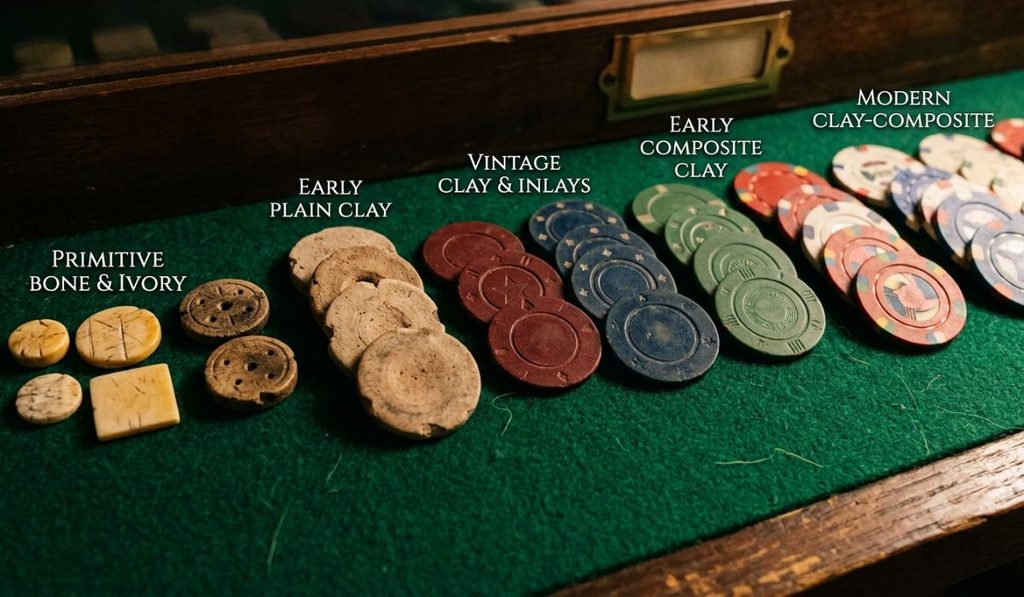
The 1880s clay chips were replaced by clay composite primarily due to durability and fragility issues. As the vintage casino chips were made up of pure clay, they started to crack down when handled relentlessly or broke when dropped on the poker tables. Though the gambling houses custom-made tokens to solve the standardization problem, they were expensive and not sustainable.
To resolve this, manufacturers began mixing clay with hard materials such as sand, plastic, or resin to create a clay composite. These chips were curated to be highly resilient against drops and cracks, subsequently resulting in a longer lifespan. Although the texture was soft like the antique casino chips, they added structural strength.
How Did Inlays, Molds, and Security Features Change Chip Design?
The forgery concern urged the manufacturer to add a branded design, house name, engraved edge spots, and design the center inlays unique to a specific casino. This turns the chips from simple tokens into a miniature work of branded design. Following this, the security features and concerns for the chip were also shifted. The colored inlay with unique denominations made it easier for anti-counterfeiting tools to identify fake casino chips.
For collectors, the addition of uniqueness aided in distinguishing authentic and fake casino chips, as they refer to the design history to this day and authenticate the chip collection. This is why it is advised to handle rare chips or chips from defunct casinos efficiently, as any wear and tear would reduce the value and authenticity of the chip.
When Did Ceramic and Injection-Molded Chips Enter the Market?
Injection-molded chips and ceramic casino chips entered the market when the manufacturing of modern casino chips was split into two: plastic, which targeted cost efficiency and mass production, and ceramic, which revolutionized the addition of security and customization.
Both these variations exist side by side alongside the clay composite casino chips rather than fully replacing them. The injection-molded plastic entered the market from the mid-1940s to the 1960s, while the ceramic casino chip dominated the market from the 1980s.
Why Does This History Matter to Collectors Today?
As mentioned earlier, the history of the casino chips helps collectors analyze a chip’s material era and narrow down its approximate age, spot inconsistencies, and cross-reference it against the known casino issues. Moreover, these casino chips act as a physical storyteller, carrying the cultural norms, triumph, and complexities of the period. Additionally, with proper data about the historical significance, rare craftsmanship will help the collector determine its value. In a way, analyzing these facts has also helped the collector understand the technical skills, material compositions, and stylistic evolution.
You can research the casino chip in your hand through various free sources like the ANA numismatic collectibles, the American Numismatic Association, renowned for coin collecting. The organization works in collaboration with third-party grading services to ensure the collectibles are authentic and accurately graded. The items regarded as ANA exhibits carry higher market value, trust, and authenticity.
Conclusion
Analyzing the history of casino chips has aided passionate collectors in understanding the authenticity, intensity of rarity and determining the value of the token they are possessing. Moreover, these historical records embrace the tangibility of a bygone era, preserving the cultural significance and tracing the evolution of stylized chips. As it is an era of online gambling where players can enjoy advanced gaming features, reviewing the historical records will show how far the sector has evolved and how even a casino chip from a defunct casino can aid you in making a huge amount.
FRequently Asked Questions
The earliest casino chips were made up of materials like ivory, bone, wood, and coins. Later, in the 1880s, clay chips entered the market.
Yes, ivory chips are rare and rich in historical significance, making them a high-value collectible for buyers.
Clay composite chips have molded inlays and edge spots; whale ceramic casino chips are printed edge-to-edge in full color. Ceramic chips were introduced to the market in the mid-1980s.
The material of the chip will help collectors and sellers date an old casino chip because pure clay chips suggest the pre-1950s, composite indicates a period post-1950s, and a ceramic or injection-molded plastic dates the chip to 1980 or later.